
Services
From strategy to execution — making omnichannel work in practice
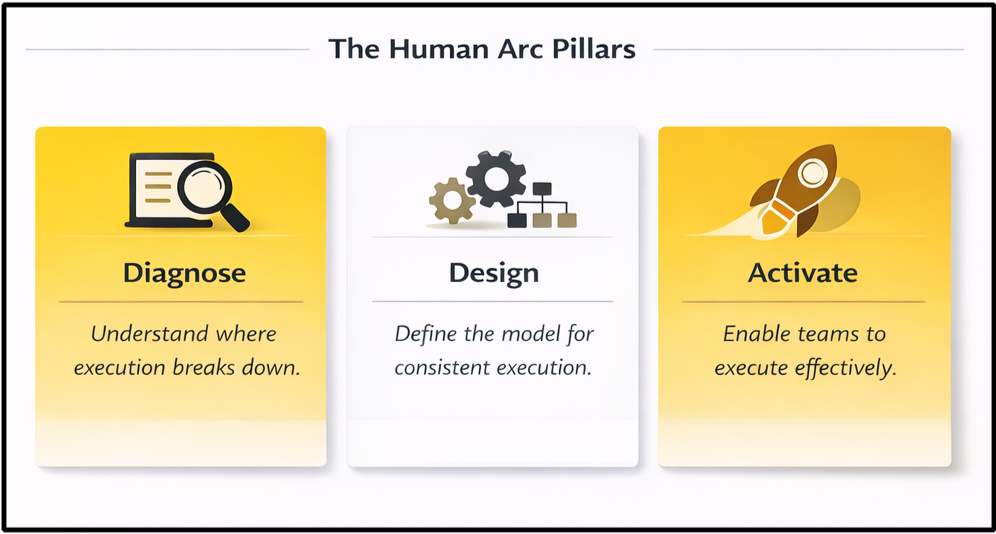
Most organisations don’t need more strategy. They need to make what already exists work — consistently, across markets and now including AI. Human Arc supports this through a focused, structured approach using the Human Arc Pillars:
Diagnose what’s breaking
Design what needs to change
Activate what makes it stick
How this works
Engagements typically begin with the Diagnostic.
From there, support can extend into Design and Activation depending on the need.
This ensures focus, clarity and momentum, without unnecessary complexity.
-
Omnichannel Execution Diagnostic (including AI readiness)
A focused diagnostic to identify why omnichannel strategy isn’t translating into consistent execution across markets.
What this addresses:
Low or inconsistent adoption
Variation in execution across markets
Strategy not translating into behaviour
Misalignment between Commercial and Medical
AI initiatives layered onto unstable foundations
What this involves:
Assessing where strategy breaks down between global and markets
Understanding how teams are actually working vs what was designed
Reviewing adoption and capability across Commercial and Medical
Identifying where omnichannel (and AI-enabled activity) is working and where it stalls
Typical outputs:
A clear, evidence-based view of why execution is breaking down and what to prioritise to fix it
Clearly defined root causes
Practical, prioritised actions
A clear path from strategy to execution
-
Operating Model & Ways of Working
Once the problem is clear, the next step is to define what needs to change to enable consistent execution.
What this focuses on
How omnichannel should work in practice
How global and regional teams interact
How cross-functional teams, i.e. Commercial and Medical Affairs, align in execution
How AI capabilities integrate into existing workflows
What this includes
Operating model design
Governance and decision-making structures
Clear roles, responsibilities and workflows
Practical frameworks that can be applied across markets
Outcome
A defined, practical model for how omnichannel operates
Not just in theory, but in day-to-day execution.
-
Capability & Behaviour Change
Even with the right model in place, execution depends on how people work.
This phase focuses on embedding capability and enabling behaviour change across teams.
What this addresses
Gaps between knowledge and application
Lack of confidence in applying omnichannel approaches
Inconsistent execution across markets
Misalignment between teams in practice
What this includes
Targeted capability programmes
Practical, applied training (not theoretical)
Workshops aligned to real workflows and use cases
Ongoing support to reinforce adoption
Outcome
Teams that are able and confident to execute omnichannel consistently in practice.