
Services
Ben works with healthcare organisations to develop transformation programmes that translate technological innovation into practical organisational capability. This includes assessing readiness for change designing operating models that support new ways of working, and building the leadership alignment and capability required to sustain adoption. The concepts below outline the framework that underpins this work.
Human Arc Framework
Based on the Human Adoption Gap, the gap between what technology makes possible and what organisations actually adopt. Companies invest in powerful tools and platforms, but real impact only happens when leadership, capability and behaviour evolve alongside the technology. This understanding forms the foundation of the Human Arc Framework.
The Human Arc Framework
Technology → Leadership Narrative → Capability → Behaviour → Adoption → Impact
-
The Challenge
Technology evolves faster than organisations can adapt.
New platforms and tools promise significant benefits, but many organisations struggle to translate technological potential into everyday practice.
Human Arc focuses on the conditions required for successful adoption.
Across industries, organisations often deploy advanced technologies but struggle to achieve meaningful adoption.
The underlying causes typically include:
unclear leadership alignment
insufficient capability development
misaligned incentives
cultural resistance to change
Why It Matters in Healthcare
Healthcare organisations operate in complex, highly regulated environments.
Transformation requires alignment across medical, commercial, regulatory and operational functions.
Closing the Human Adoption Gap is therefore critical to ensuring that new technologies ultimately improve patient outcomes.
The Fix
Technology introduces new possibilities.
Leadership must articulate why the change matters.
Organisations must develop the capability required to operate new models.
People must adapt behaviours and incentives.
Only then does real adoption occur.
The Result
When these elements align, technology becomes embedded in everyday work and transformation delivers measurable impact.
The Three Pillars of Human Arc
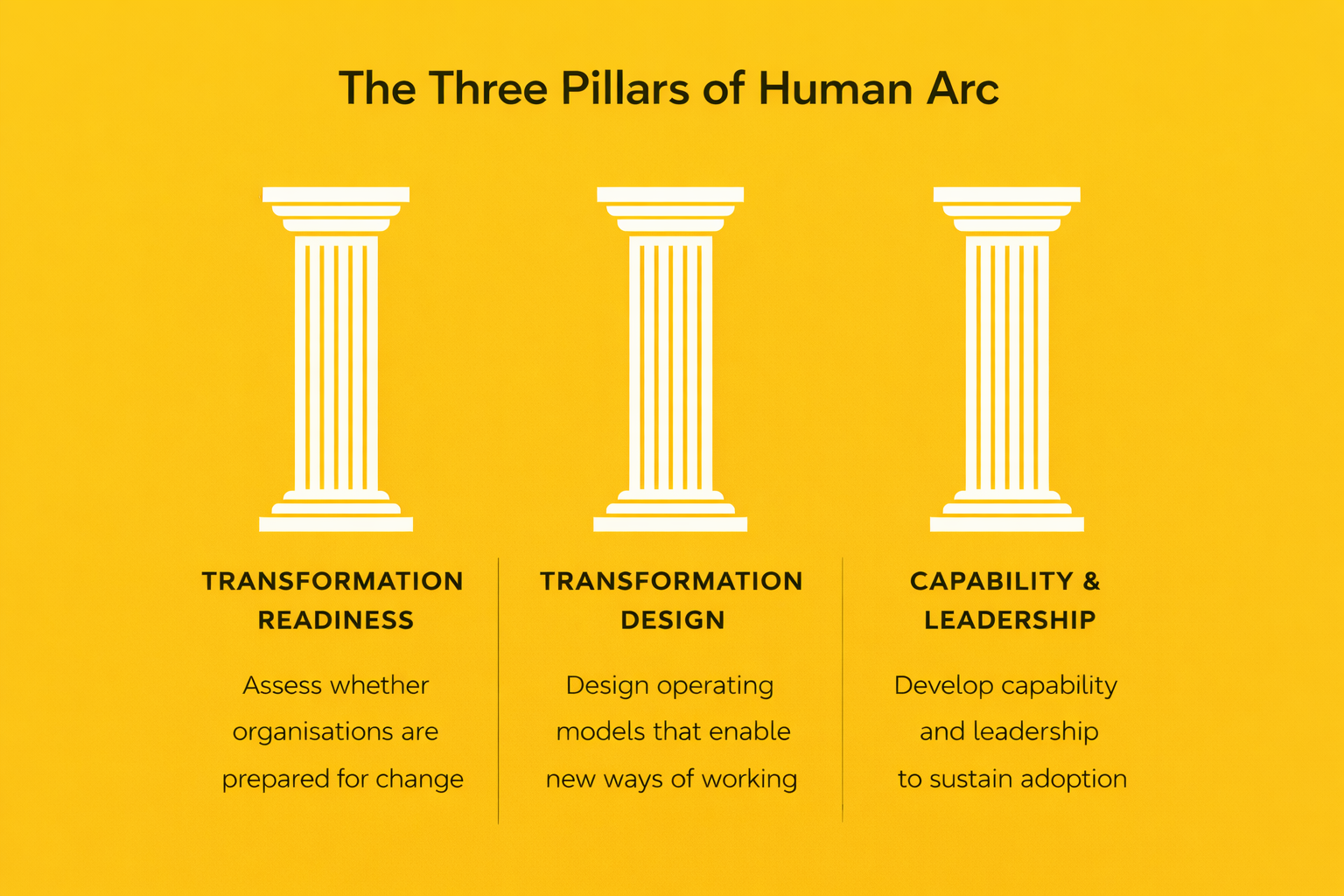
The Three Pillars of Human Arc describe how organisations can close the Human Adoption Gap. They focus on three essential conditions for successful transformation:
Transformation Readiness: understanding whether an organisation is ready for change
Human-Centred Transformation Design: designing operating models that support new ways of working
Capability Architecture & Leadership Advisory: building the leadership and capability required to sustain them
Together, these pillars form the foundation of Human Arc’s service offering, helping organisations assess readiness, design human-centred transformation approaches, and develop the capability needed to translate technological innovation into real organisational impact.
-
1) Transformation Readiness
Assess whether organisations are truly prepared for technological change.
Many transformation initiatives struggle because organisations underestimate the human conditions required for adoption.
Human Arc helps leadership teams evaluate readiness by examining:
leadership alignment
organisational capability
behavioural barriers
technology utilisation
This diagnostic approach identifies where transformation efforts are likely to stall and where focused intervention will have the greatest impact.
Typical outputs include readiness assessments, leadership insights and strategic recommendations.
2) Human-Centred Transformation Design
Design organisational models that enable technology to deliver real impact.
Technology alone does not transform organisations. Sustainable change requires operating models, governance structures and behavioural alignment that support new ways of working.
Human Arc supports organisations in designing transformation approaches that integrate:
governance and decision-making structures
engagement and operating models
behavioural incentives
cross-functional alignment
The goal is to ensure that technological initiatives translate into consistent, scalable practice across the organisation.
3) Capability Architecture & Leadership Advisory
Develop the leadership and capability required to sustain transformation.
Even well-designed transformation initiatives fail when organisations lack the capability to operate them.
Human Arc works with leadership teams to strengthen the human foundations required for long-term success, including:
capability frameworks and learning pathways
leadership alignment and decision-making
organisational coaching and enablement
strategic narratives that support change
Advisory and Speaking
Much of the conversation around technological change focuses on platforms, tools and systems.
Ben focuses on the organisational conditions required for those technologies to succeed.
Much of this work draws on the Human Arc framework, which explores how leadership, capability and behaviour shape the adoption of new technologies.
This perspective helps organisations move beyond experimentation toward sustainable adoption and meaningful impact.
-
Key Topics
Ben speaks and advises on themes including:
The Human Side of Technological Transformation: Why many transformation programmes struggle and what organisations can do to close the gap between technological potential and real adoption.
AI and Organisational Capability: How organisations can build the skills, governance and leadership models required to adopt artificial intelligence responsibly and effectively.
The Future of Omnichannel Engagement in Healthcare: How engagement models are evolving and what pharmaceutical organisations must do to move beyond channel execution toward coordinated engagement ecosystems.
Leadership and Behaviour Change in Complex Organisations: Why transformation ultimately depends on leadership alignment, organisational capability and the behaviours that shape everyday decision-making.
Human-Centred Transformation: How organisations can balance technological innovation with ethical responsibility, employee engagement and patient impact.
Types of Engagement
Ben works with organisations through a range of formats, including:
Internal Transformation Programmes: Helping organisations reflect on how new technologies affect ways of working, capability development and leadership decision-making.
Leadership Workshops: Facilitating discussions that help leadership teams examine transformation challenges and align around strategic priorities.
Advisory Sessions: Supporting organisations as they navigate complex change initiatives involving technology, capability and organisational design.
Conference Keynotes and Panel Discussions: Exploring the implications of technological change for healthcare organisations.